Lesson 2.2: QCP’s Role in Supporting ACQF Implementation
Description: In this lesson, you will see how the QCP puts the ACQF into practice. We will focus on how it improves transparency, comparability, and recognition of qualifications.
By the end of this lesson, you will be able to:
- Explain how the QCP puts the ACQF into practice, improves transparency, comparability, and recognition of qualifications
- Describe how the QCP supports all countries, whether through database integration or manual data entry
- Recognise the value of structured, standardised data for policy-making and future-ready qualifications systems
As introduced in Lesson 2.1, the QCP is the ACQF’s digital backbone. This lesson looks at the two paths countries can take to connect their qualifications data to the QCP.
Today’s learners, workers, and employers face barriers when qualifications are hard to compare across borders. The African Union with the support of its European partners has developed the ACQF to overcome this challenge, fostering a more integrated, mobile, and competitive continent.
ACQF provides the policy framework for qualifications comparability. But achieving real, cross-border recognition and mobility requires more than agreements. It needs reliable, accessible, structured qualifications data. That’s where the QCP comes in.
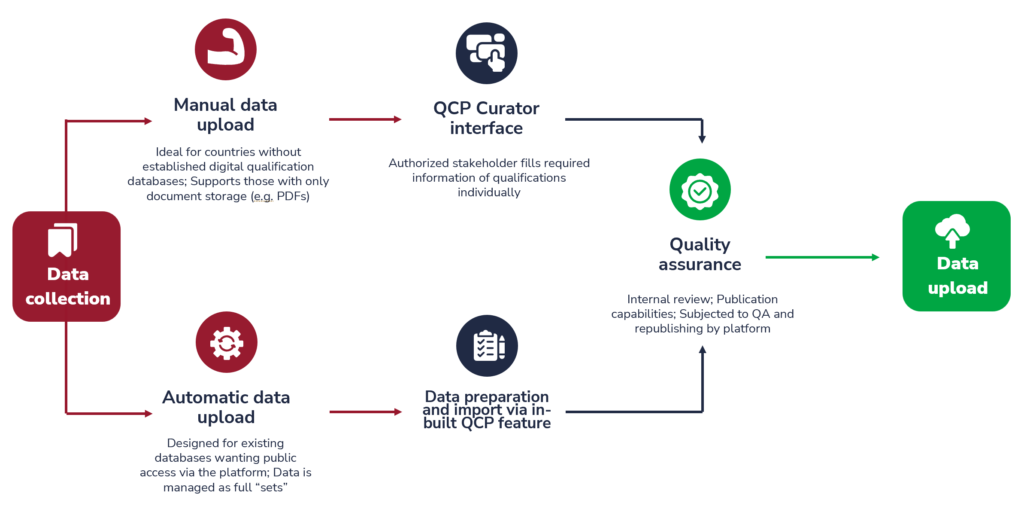
The QCP is inclusive by design. Countries with structured qualifications databases can connect directly through automated systems. Those without an NQD can use the QCP’s curator interface to manually enter and manage qualifications data. This ensures no country is left behind.
For manual entry, an authorised curator fills in each qualification’s required information individually through the Curator Interface. Once entered, it goes through internal quality assurance review before being published. For countries with an existing, structured database, the automated path works differently: data is prepared in the QCP format and imported as a full set, either as a bulk upload or through an API. Automated uploads are published as soon as they have been processed, without a separate review step, so careful preparation and validation before upload are essential. You will learn more about both paths in Modules 4 and 5.
But the QCP is so much more – it also allows countries to organise their own data following international standards and set themselves up for a future-proof and modern qualifications system. Structured, standardised qualifications data is the basis for advanced work: policy forecasting, analysing skills gaps and needs, and creating useful qualifications and employment data for stakeholders beyond government – citizens, education providers, employers and society at large.
To make this concrete: imagine a ministry of education using QCP data to spot that very few learners in a region are qualifying in a particular technical trade, despite strong local employer demand for it. That gap becomes visible because the data is structured and comparable — the ministry can then use it to justify funding a new training programme in that trade.
References
About the Qualifications and Credentials Platform (ACQF)