
Lesson 4.2: Data Mapping and Preparation
Description: In this lesson, you will get detailed guidance on mapping national qualification data to the African Learning Model (ALM) format required by the QCP. It covers field-by-field mapping instructions with practical examples from actual qualifications (for example, the South African and Mauritian qualifications used during training).
By the end of this lesson, you will be able to:
- Define data mapping and explain its critical importance for the ACQF QCP.
- Describe the principles of mapping national qualification data to the African Learning Model (ALM).
- Apply field-by-field mapping instructions using practical examples from national qualifications.
- Name common challenges in data mapping and appropriate solutions.
- Understand the role of metadata in the data mapping process.
- Explain basic ETL (Extract, Transform, Load) concepts relevant to data preparation.
Practical field-by-field mapping instructions to ALM
This section provides guidance on mapping common national qualification data elements to the African Learning Model (ALM). National curators must always refer to the latest official ALM documentation portal and QCP guidelines for definitive field names, definitions, data types, and controlled vocabularies.
You can visit the official data architecture of QCP on this website: ACQF Qualifications and Credentials Platform (QCP).
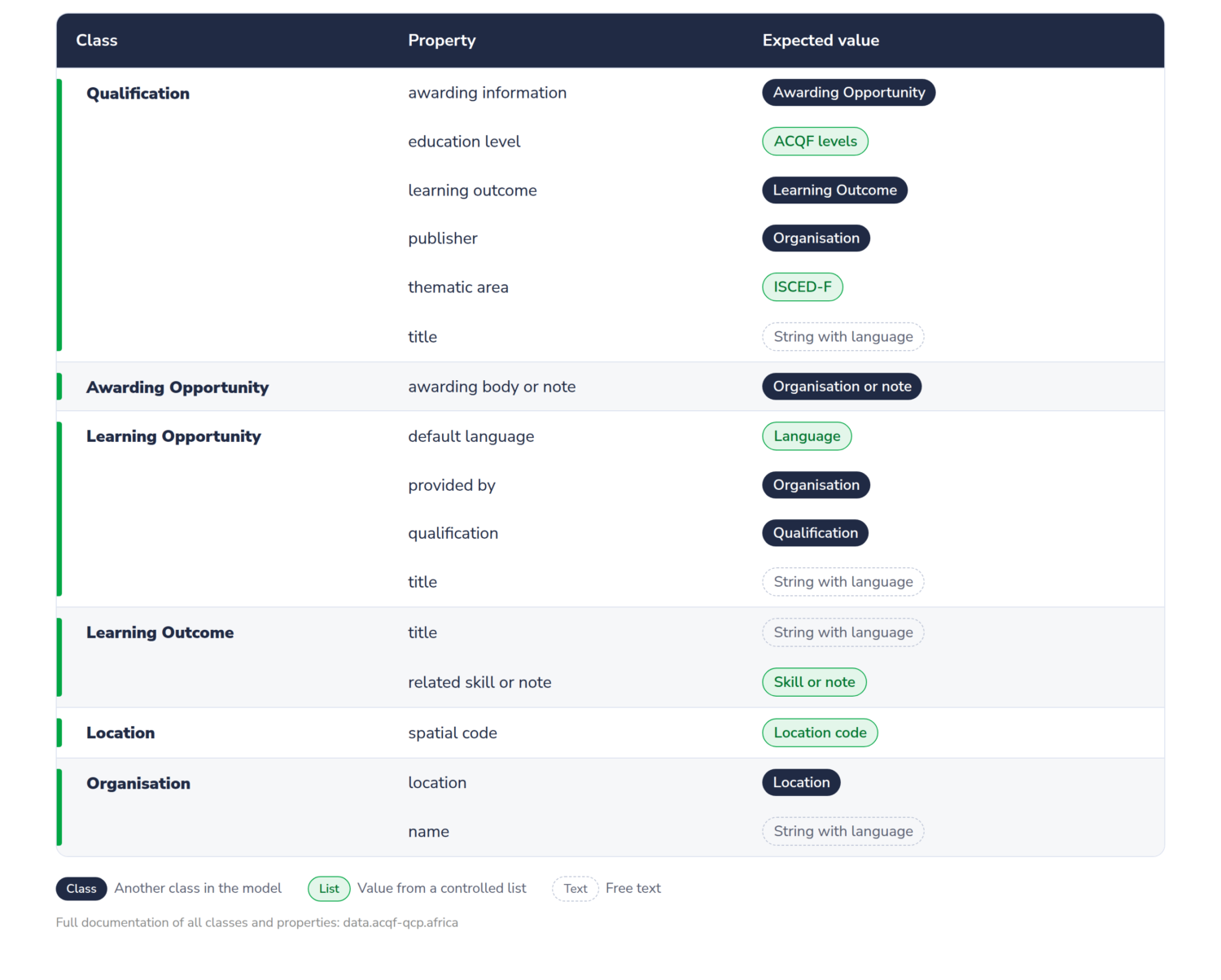
The table below presents a simplified overview of the core model. For detailed documentation and an in-depth description of classes and properties follow this link: data.acqf-qcp.africa/exchange-model/exchange-model.html.
Phase 2: Detailed field-by-field execution of mapping
The video above walks you through the three phases of mapping national qualifications data to the African Learning Model (ALM): planning the mapping (Phase 1), carrying it out field by field (Phase 2), and validating and maintaining the result (Phase 3). This text goes into more detail on Phase 2, because this is where you need concrete guidance and worked examples that you can come back to while mapping your own data.
What field-by-field mapping involves
In Phase 2, you transfer data from your national sources to the ALM and transform it where necessary. The mapping rules and specifications you prepared in Phase 1 (see the video) guide this work.
In practice, mapping means finding the correct and meaningful equivalent in the ALM for each piece of national qualification information. You take a specific field in your national system, for example Qualification Name or NQF Level, and identify where it belongs in the ALM, for example the title property of the Qualification class, or the NQF level field.
This is more than a technical data transfer. It is an act of careful translation that requires a good understanding of both the source context (the nuances of your national qualifications system) and the target context (the structure of the ALM and its intended use). If you misinterpret a source field or apply the wrong transformation rule, the data may appear in the QCP but be semantically incorrect, misleading or unusable. National qualifications systems have their own, often deeply embedded, terminology and structures, so the people doing the mapping need to be “bilingual”: confident in both the national and the ACQF “language”.
Mapping is a separate step from entering qualifications through the QCP Curator interface (see Lesson 4.1). First, the mapping exercise helps you decide whether your data can be imported automatically or has to be entered manually. Second, by the time you enter qualifications manually in the Curator interface, you should already know how each piece of your national data translates to the ALM.
Worked examples
Throughout this section, two publicly accessible qualifications serve as worked examples:
- A qualification registered by the South African Qualifications Authority (SAQA): https://allqs.saqa.org.za/showQualification.php?id=115821
- A qualification registered by the Mauritius Qualifications Authority (MQA): https://mqa.govmu.org/mqa/wp-content/uploads/2022/04/National-Certificate-Level-5-in-Sales-and-Marketing.pdf
Each step below ends with a table showing how both examples map to the fields of the QCP Curator interface.
Step 2.1: Mapping core qualification identifiers (core element)
- National data elements: key identifiers include the official qualification title, the national qualification code or ID, related documents (e.g. a nationally stored qualification file) and webpages.
- ALM target fields: the ALM has fields for the qualification title and for your national qualification code or ID. It also lets you link related documents and add a homepage URL.
Mapping instructions
- Titles should generally be mapped directly. The ALM can hold a qualification title in several languages at the same time. You do not have to translate titles into more widely used languages, but doing so is recommended because it makes qualifications more comparable across the continent.
- Make sure national qualification codes or IDs are unique within your national context. The ALM accepts alphanumeric identifiers.
- Add the URLs of relevant documentation for the qualification, or of webpages that hold information about it.
Step 2.2: Mapping qualification levels and their equivalence to ACQF levels
Given their importance, qualification levels are discussed separately.
- National data elements: the NQF level assigned to the qualification, and the ACQF level if the NQF has been formally referenced to the ACQF.
- ALM target fields: separate fields for the NQF level and the ACQF level.
Mapping instructions
- Map the national NQF level directly.
- If your country’s NQF is officially referenced to the ACQF, map the corresponding ACQF level.
- If your NQF has not yet been referenced to the ACQF, you can leave the ACQF level field blank. We strongly suggest contacting the ACQF team of experts to start the referencing process.
The table below shows how both examples map to the fields covered in Steps 2.1 and 2.2. The Thematic area and Related occupation fields use controlled lists, meaning they take predefined values; Step 2.4 explains how to map to them.
Table 1: Mapping example – core identifiers and levels (General section)
| Field | Example 1 – South Africa: Bachelor of Education Honours in Chemistry Education | Example 2 – Mauritius: National Certificate Level 5 in Sales and Marketing | Description | Comment |
|---|---|---|---|---|
| Title | Bachelor of Education Honours in Chemistry Education | National Certificate Level 5 in Sales and Marketing | ||
| Reference ID | 115821 | |||
| ACQF Level | An associated level of education within a semantic framework describing education levels. | |||
| NQF Level | Level 8 | Level 5 | An associated level of education within a semantic framework describing education levels. | |
| Thematic area | 0114 Teacher training with subject specialisation | 0414 Sales and marketing | The thematic area according to the ISCED-F 2013 classification. It should be provided using the ISCED-F controlled vocabulary. | ISCED-F 2013 |
| Related occupation | Teaching professionals | Sales, marketing and public relations professionals | An occupation or occupational category. If provided, the value should come from a controlled vocabulary. | Occupations | ESCO |
| Homepage | https://www.saqa.org.za/ | http://mqa.govmu.org/ | ||
| Other documents | SAQA qualification record (ID 115821) | MQA qualification document (PDF) |
Step 2.3: Mapping learning outcomes (core element)
- National data elements: statements describing what a learner knows, understands and is able to do after successfully completing the qualification. In your national system these may not be called learning outcomes: many countries work with exit-level outcomes, competency-based frameworks, or learning objectives or goals. Because the ACQF is built on a learning outcomes approach, these will need to be transformed into learning outcomes.
- ALM target fields: the title field for learning outcomes. Every qualification needs at least one learning outcome.
Mapping instructions
- If your country uses a learning outcomes approach: enter each learning outcome statement from the national source separately in the ALM.
- If your qualifications do not specify learning outcomes: follow guidelines such as those developed by Cedefop for writing short, clear and effective learning outcome statements (Cedefop handbook).
- The Related skills field uses a controlled list and is covered in Step 2.4.
Table 2: Mapping example – learning outcomes
| Field | Example 1 – South Africa: Bachelor of Education Honours in Chemistry Education | Example 2 – Mauritius: National Certificate Level 5 in Sales and Marketing | Description | Comment |
|---|---|---|---|---|
| Title | 1) Prepare learners for research knowledge and skills for further postgraduate studies in Masters in education in Chemistry Education or another relevant Degree in education.2) Consolidate specialised and theoretical knowledge in Chemistry Education.3) Develop research capacity in the methodology and techniques of Chemistry Education.4) Provide learners with theoretical engagement and intellectual enhancement in Chemistry Education.5) Develop a systematic array of current thinking, practice and research methods in Chemistry Education as well as their application to educational settings.6) Ability to use research projects to conduct and report on research under the supervision of a competent and qualified academic staff. | 1) Communicate product information to sales clients2) Develop and coordinate the sales team3) Implement personal selling strategies to achieve targeted results4) Identify, interpret, and apply direct selling techniques and strategies5) Demonstrate and apply accounting skills for sales operations and activities6) Structure, develop, and manage sales territories7) Manage sales operations to achieve objectives8) Produce and present sales proposals9) Provide sales administration and support services10) Produce and coordinate sales promotion programmes11) Implement a sales plan for product and services12) Demonstrate and apply knowledge of sales management13) Demonstrate and apply principles of marketing14) Create and maintain a safe and supportive working environment15) Demonstrate and apply professional and ethical conduct16) Use information technology17) Develop strategies to establish and maintain positive workplace relationships18) Establish social, ethical, legal, and regulatory parameters for public relations activities19) Lead a group/team to achieve an objective(s)20) Demonstrate an understanding of the principles of implementing and managing an e-Commerce website21) Demonstrate knowledge of email marketing | The title. One value per language is allowed. | In the Curator interface, each learning outcome has its own entry, with its own “Further details” and “Related skills” fields. |
| Further details | An additional free-text note about the resource. | Each learning outcome has its own Further details field. | ||
| Related skills | 1) chemistry2) teach chemistry3) scientific research methodology4) teach chemistry5) education science6) assist scientific research | 1) sales argumentation2) team building, manage sales teams3) implement sales strategies, sales argumentation4) implement sales strategies5) accounting6) sales activities7) set sales goals, sales strategies8) draw up marketing and sales plan, sales argumentation9) office administration, sales activities10) sales strategies11) implement sales strategies12) manage sales channels, manage sales team13) marketing principles14) maintain a safe, hygienic and secure working environment15) follow ethical code of conduct16) use IT tools17) building and developing teams18) advise on public relations19) lead a team20) e-commerce systems, manage website21) digital marketing techniques, execute email marketing | Skills related to the learning outcome. Values come from the ESCO skills classification. | ESCO skills |
Step 2.4: Mapping qualification attributes to controlled lists or vocabularies (skills, competences and occupational links)
Where the ALM uses standardised lists, taxonomies or controlled vocabularies, your national data has to be mapped to them accurately. This is what makes the data consistent and interoperable, and what allows qualifications to be compared across African countries.
To do this, you need to know the target vocabulary or classification well, whether it is an international classification such as ISCED-F or ESCO, or an ACQF-specific typology.
For your national mapping exercise, define how your national classifications are translated into these lists. There are three ways to approach this:
- Direct use: if your national system already uses or is aligned with the target standard, mapping may be straightforward.
- Crosswalks: for systematic mapping, we strongly recommend developing or using existing national crosswalks (mapping tables) between your national classifications and the international standards.
- Expert judgement: finding the closest international equivalent case by case. This is possible, but it raises concerns about how consistently the mapping is carried out.
Below, we list each national data element with its target controlled field. We do not give further instructions here: how you approach mapping to these fields is a decision for your national team.
A. Qualification: related thematic area and occupation
- National data elements: information linking the qualification to occupations in the labour market (as defined nationally), and to the thematic area of training or study.
- ALM target fields: ESCO occupations; ISCED-F 2013 for the thematic area of the qualification.
B. Learning outcomes: related skills
- National data elements: information linking the qualification to specific skills or broader competences.
- ALM target fields: ESCO skills.
C. Accreditation: type of accreditation
- National data elements: domestic accreditation and quality assurance methodologies at institutional and programme level.
- ALM target fields: the ACQF-specific list of accreditation types.
D. Credit points: credit point framework
- National data elements: national credit accumulation and transfer systems.
- ALM target fields: the ACQF-specific list of credit accumulation and transfer frameworks.
Step 2.5: Mapping other qualification attributes
With identifiers, levels, learning outcomes and controlled lists mapped, the last step is to map the remaining attributes. These add important context and detail and give a complete picture of the qualification in the QCP.
The tables below cover the remaining sections of the Curator interface: accreditation, credit points, awarding opportunities and learning opportunities, including the controlled fields described in Step 2.4.
Table 3: Mapping example – accreditation
| Field | Example 1 – South Africa: Bachelor of Education Honours in Chemistry Education | Example 2 – Mauritius: National Certificate Level 5 in Sales and Marketing | Description | Comment |
|---|---|---|---|---|
| Title | Missing information | Missing information | The title. One value per language is allowed. | |
| Type | Missing information | Missing information | The type of accreditation. It should be provided e.g. using the ACQF Controlled List of Accreditation Types. | The ACQF controlled list for accreditation types is not finalised yet. |
| Accrediting organisation | CHE – Council on Higher Education | The quality assuring authority (i.e. assurer). | ||
| Accreditee | University of Venda | The organisation whose activities are being accredited. | ||
| Expiry date | 30/06/2031 | The date when the accreditation expires or has expired. |
Table 4: Mapping example – credit points
| Field | Example 1 – South Africa: Bachelor of Education Honours in Chemistry Education | Example 2 – Mauritius: National Certificate Level 5 in Sales and Marketing | Description |
|---|---|---|---|
| Points | 120 | 104 | The credit points assigned to the learning specification. |
| Framework | Credit Accumulation and Transfer within the National Qualifications Framework | MQA CATS | The framework used to assign the credit points to the learning specification. It could be provided using the ACQF Controlled List of Credit Systems (this taxonomy is not finalised yet). |
Table 5: Mapping example – awarding opportunities
| Field | Example 1 – South Africa: Bachelor of Education Honours in Chemistry Education | Example 2 – Mauritius: National Certificate Level 5 in Sales and Marketing | Description |
|---|---|---|---|
| Awarding body | University of Venda | The awarding body related to this awarding activity (i.e. the organisation that issues the qualification). The cardinality is greater than 1 only in cases of co-awarding or co-graduation, where two or more organisations issue the qualification to an individual. | |
| More information | An additional free-text note about the resource. |
Table 6: Mapping example – learning opportunities
| Field | Example 1 – South Africa: Bachelor of Education Honours in Chemistry Education | Example 2 – Mauritius: National Certificate Level 5 in Sales and Marketing | Description |
|---|---|---|---|
| Title | Bachelor of Education Honours in Chemistry Education | The title. One value per language is allowed. | |
| Provider | University of Venda | The organisation providing or directing the learning opportunity. For joint qualifications, for example, several organisations may direct the learning opportunity. | |
| Language of instruction | English | The base language of the learning opportunity, to be considered authoritative. |
After Phase 2
Once your data is mapped, you move on to Phase 3: piloting the mapping on a sample of qualifications, validating the data, rolling out the full mapping and keeping it up to date. Phase 3 is covered in the video above, and Lesson 4.3 looks at data quality assurance in more detail.
References
ESCO Classification: Occupations
ESCO Classification: Skills & Competences
Defining, Writing and Applying Learning Outcomes: A European Handbook (Cedefop, 2017)
QCP Training Unit 3: Mapping and Standardising Qualifications Data
QCP Training Unit 4: Integrating Learning Outcomes into Qualifications Databases